
 One Rep MaxGet the app
Track your one rep max on every lift.
Know your max without ever testing one.
Log any hard set and get an estimated 1RM averaged across seven formulas, the percentage table you train off, and the plates to load. Then watch the number climb.


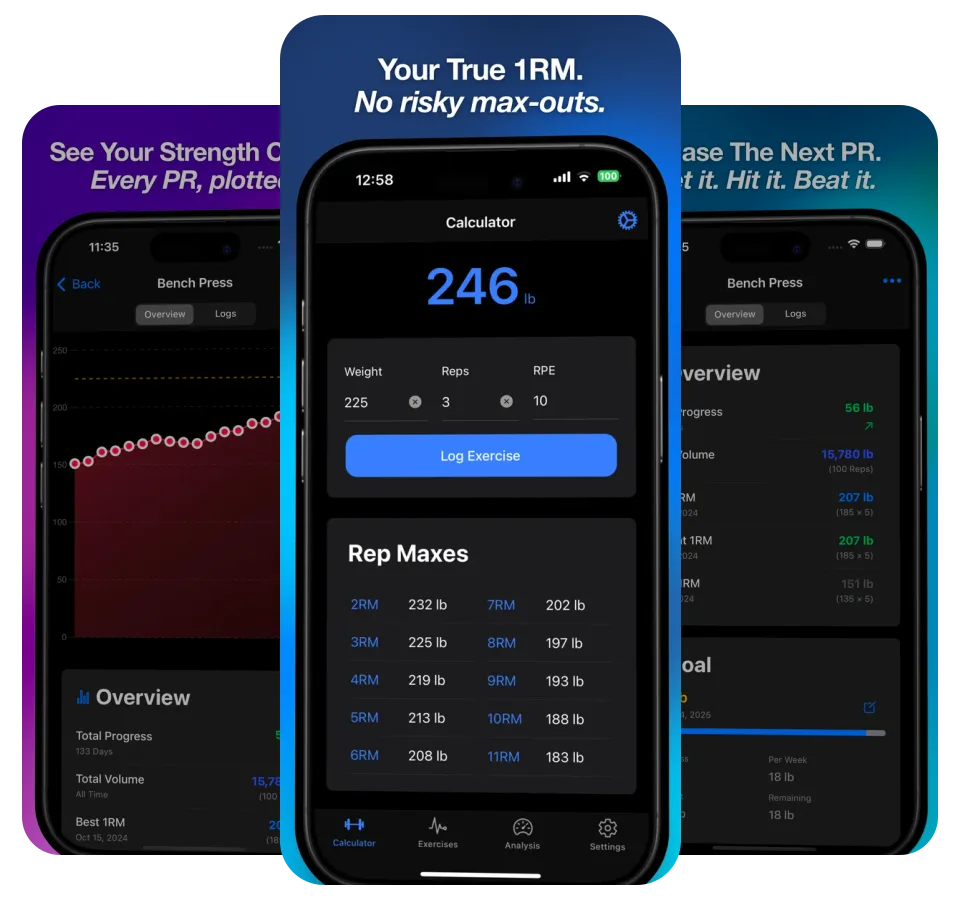
See it in action
An estimate from any set, every formula side by side, the plates to load, and a chart of every lift so you can see your max climbing.
Everything a max is good for
The calculator is where it starts. The app keeps every number, turns it into the weights you load, and shows you whether it is going up.
A max from any set
Enter the weight, the reps and how hard it felt. The estimate averages seven formulas, and you can switch off any you do not trust.
Rep maxes and percentages
Every rep max from 2RM to 11RM and every training percentage, worked out from your current max.
Plates per side
Each percentage comes with the plates to load and the nearest weight your plates can actually make, in pounds or kilos.
Every lift in one place
Squat, bench, deadlift, press or anything else, each with its current and best 1RM side by side.
Watch it climb
Every logged set is plotted, so a lift that is moving and a lift that has been flat since spring look completely different.
A number to chase
Set a target max and a date, and the app tracks how much you have added, how much is left, and the pace you need.
Estimate instead of testing
Testing a true one rep max is taxing, needs a spotter, and is only accurate on the day you do it. A hard set of three to five gives you a number that is nearly as useful and costs you nothing. Since most programs are written as percentages of a max, that estimate is the number you actually need.
Enter the weight, the reps, and optionally how hard the set felt. You get the estimate and the whole rep max table underneath it.
Seven formulas, not one opinion
Epley, Brzycki, Lombardi, Mayhew, McGlothin, O'Conner, and Wathan all estimate the same thing and all disagree, sometimes by several percent. Rather than pick one silently, the app averages them, and you can switch any of them off if you prefer a particular one.
If you want the math behind them, the guide to calculating a one rep max works through the equations and where they diverge, and our one rep max calculator runs all seven in the browser if you want to try it before installing anything.
Where to go next
Once you have a max you trust, the 5/3/1 app will build a full training cycle from it, and the barbell plate calculator turns any working weight into the plates to load.
Common questions
Is the One Rep Max app free?
How many reps should I use for the best estimate?
Which formula is most accurate?
What does the RPE field do?
Do I need to test a real max to use this?
Does it work in kilos?
Why is the suggested weight not exactly the percentage?
Stop guessing your max. Start tracking it.
Free on iPhone and Android.