
German Volume Training
The original five-day GVT split ready to run, plus full control over exercises, tempo, rest and loading if you want to build your own.


The classic split
The five-day rotation the program is known for:
- Day 1: Chest & back
- Day 2: Legs & abs
- Day 3: Rest
- Day 4: Arms & shoulders
- Day 5: Rest
Given the recovery cost, many lifters do better hitting each body part once a week rather than following the rotation strictly. The app will run either.
- The original five-day GVT split, ready to go
- Strict 90-second rest timers on main lifts, 60 on accessories
- Weight only advances when all ten sets of ten are complete
- Tempo guidance per movement type
- Customize exercises, sets, reps, rest and loading
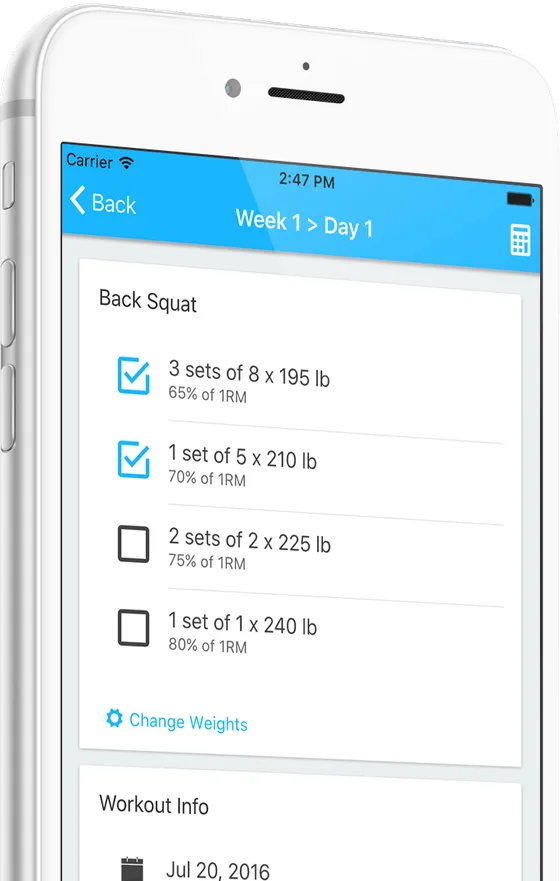
How to run it
- Exercises: one 10×10 movement per muscle group, and make it a compound. Machines do not justify the volume.
- Sets and reps: 10×10 on the primary lift, 3×12 on assistance.
- Rest: 90 seconds on main lifts, 60 on accessories. Strictly. The short rest is the stimulus.
- Pairing: work antagonistic groups together: chest and back, overhead press and a lat movement, quads and hamstrings, biceps and triceps.
- Starting weight: about 55% of your one rep max, or a load you could manage for a single set of 20.
- Adding weight: only once you complete all ten sets of ten. Never train to failure on any set.
- Frequency: hitting each muscle group every four to five days is about right.
- Tempo: a four-second negative on long-range movements like squats, dips and pull ups; three seconds on shorter ranges like curls and triceps extensions.
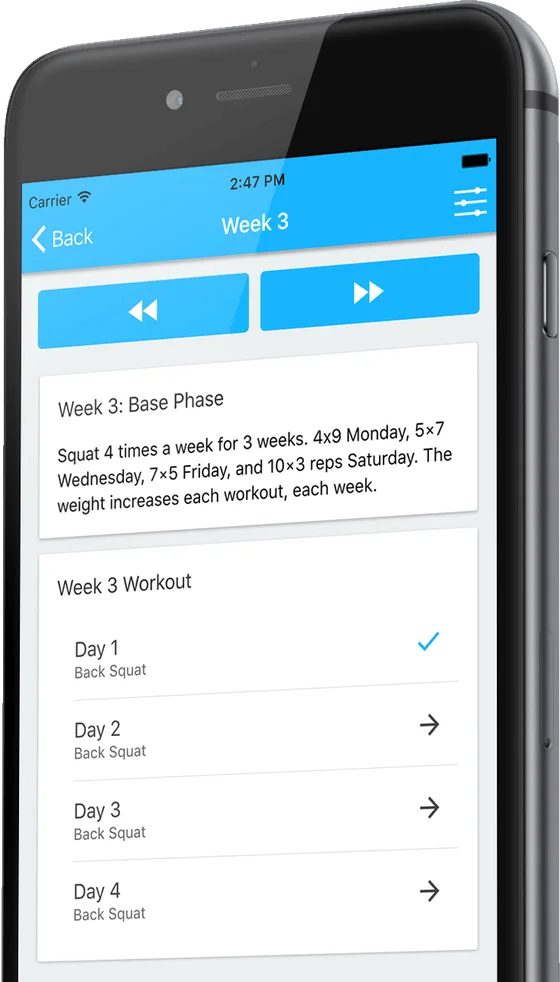
Where it came from
German Volume Training was popularised by German national weightlifting coach Rolf Feser and later by Canadian strength coach Charles Poliquin, who credited it with the leg development of Team Canada lifter Jacques Demers. Bev Francis has said she used it during her early bodybuilding years. The claim that followed it around European weight rooms was that lifters would move up a weight class in twelve weeks.
What it demands
A hundred working reps on a compound lift is a serious recovery load. Eat aggressively while you run it, and if you are dragging, cut the frequency before you cut the sets. The volume is the program.
Common questions
What weight should I start with?
What if I cannot finish all ten sets of ten?
How long should I run GVT?